
Caveat: This post is about my experience of applying for the Digital Nomad Visa for Italy from the London consulate in July 2026. It’s in no way legal advice. However, if you’d like a recommendation for a legal partner, come find me in the comments. I worked with a wonderful one.
In May 2025, I was on the train from Dorset to a friend’s wedding in London, and I remember thinking:
I think I want to move to Italy.
One year and two months, 800 pages, seven hire cars, and five months of long-distance loving and longing later, that thought turned into a Digital Nomad Visa-shaped stamp on my British passport. I applied on the 8th July. Then, 21 days later, I picked up the brown paper letter at the consulate with the Visa inside.
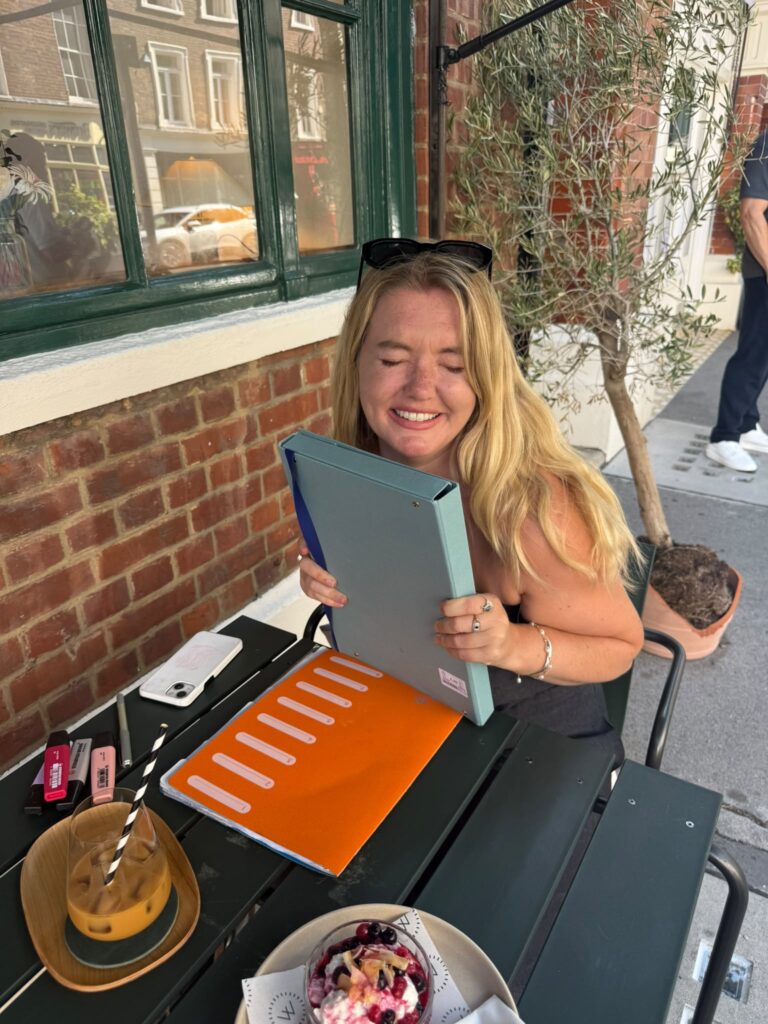
The experience felt like a game of “If I fall, will you catch me?” with the universe and the Italian government. In the same breath, it became a question of how much you can really trust the process. Especially when nothing is truly in your control.
If you’re dreaming of moving to Italy, here’s everything I would tell myself and do differently if I had to do this again.
Running order:
- What is the Digital Nomad Visa
- Digital Nomad Visa Paperwork
- Preparing for the Appointment
- What to Expect In the Consulate Appointment
- The Wait
- Reckoning Day
What is the Digital Nomad Visa?
The Digital Nomad Visa (DNV) for Italy was introduced in April 2024. By Visa standards, it’s really not old at all. That means that many consulates and embassies are still unfamiliar with it.
Plus, one of its lovable quirks is that it’s really not nomadic at all. In fact, it very much asks you to settle with a fixed address for 12 months.
Requirements
In simple terms, if you tick these, you’re eligible to apply for the Digital Nomad Visa:
- You earn more than €28,000 per year through remote-only work (some baselines start at €25,500, it’s worth double-checking).
- You have a degree.
- You can prove that you have 6+ months of remote experience.
If you’re eligible, it’s a matter of putting the paperwork together. You can do this with a legal specialist, as I did, or by yourself.
Digital Nomad Visa Paperwork
My final application was around 800 pages. However, most of that was made up of a year’s worth of invoices and bank statements.
In no particular order, the most important pieces that make up your application are:
A 12-month minimum lease
This could be somewhere you rent or have bought, but it cannot be an Italian friend’s garage or an Airbnb.
The contract must cover the 12 months after your planned arrival date and be registered with the Agenzia delle Entrate. For instance, I took an 18-month lease from March 2026 for a September 2026 arrival date. You must also include both the contract and the registration certificate in your application.
Unfortunately, you have to take the hit of paying rent on a property you’re not yet living in. In some cases, you can also negotiate early exit clauses with landlords.
Your Codice Fiscale
To get the above rental address, you will need a Codice Fiscale. This is a 16-letter code that’s your Italian tax identification number. There are a few ways to get it.
- The first is to apply in person at an Italian tax office, the Agenzia delle Entrate, while you’re in Italy. You’ll need your passport and, ideally, your rental address.
- The second is to apply for free through an Italian Consulate or Embassy.
- The third, and the route I took, is to work with a lawyer who can obtain it remotely on your behalf. This is the more expensive option but considerably less stressful if your Italian is limited and you’re navigating the process from the UK. When I went with my landlady to get the Codice Fiscale in person, I was initially told it was impossible without a visa — one of the classic chicken-or-egg paradoxes that comes up repeatedly in this process.
A CIMEA certificate or Declaration of Value
My biggest piece of advice is to request your degree and transcripts from your university the moment you decide to apply. Universities can be slow, and CIMEA, the Italian body that validates foreign qualifications, currently takes around 60 working days. Once you’ve submitted, check the CIMEA portal regularly. I missed an update for weeks and could have applied months earlier if I caught it sooner.
Two years of tax returns and financial documentation
These must prove you earn more than €28,000 a year (true, as of August 2026) and that this money is landing in your personal accounts. I found the most helpful way to show this was to log into my HMRC account and download my Self Assessment tax calculations for every available year. I then printed 12 months of personal bank statements, highlighting every salary payment and dividend from my company, and asked my accountant for an income verification letter confirming my annual earnings.
Once you have the above, it all gets a little easier.
Booking an appointment with VFS Global
You find an appointment with VFS Global here. Check regularly as slots do appear. I’d recommend putting in 5 mins every morning and evening every day to check the platform until you find one.
Once you’ve found an appointment, print off your confirmation as a PDF. Then:
- Book a one-way flight after your planned visa start date (mine was for the 31st August, 23 days away from my appointment)
- Get health insurance for the full year
- Write a cover letter explaining your personal motivations for moving to Italy
- Include your CV, emphasising your digital expertise
- Prrint all invoices from the last twelve months
- Upload clear scans of your passport and driving license
Other documents that can help:
- Recommendation letters from your employees or clients
- One or two pages showing your social media and online presence, like screenshots of your LinkedIn, Instagram, and Substack. (The Writing Scrap Bowl absolutely featured)
The hardest part was proving the finances. Working with a legal partner here was invaluable.
Preparing for the appointment
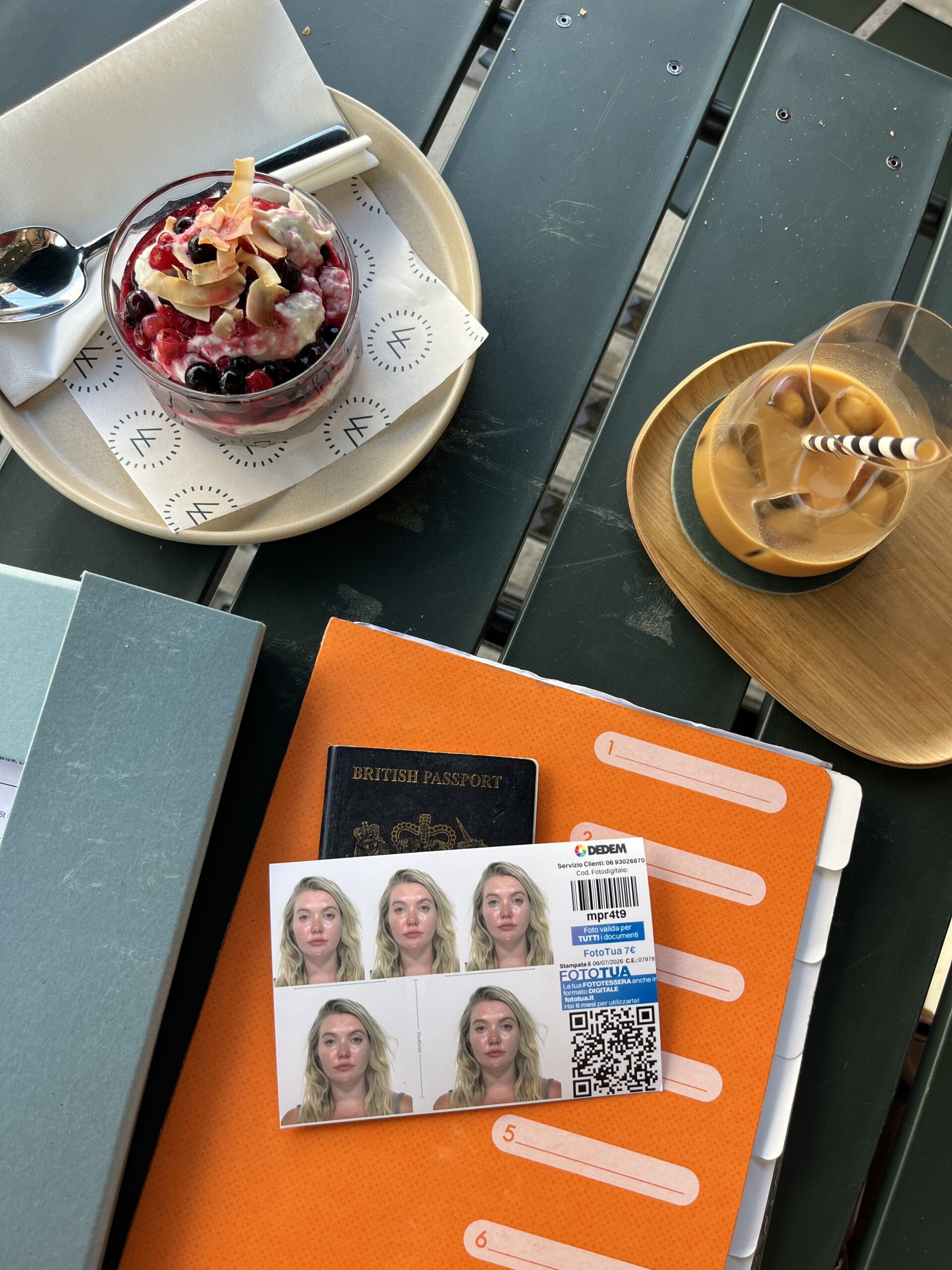
I printed everything off in a small stationery shop in town in Italy, bought a binder, and took some very sweaty passport photos in a kiosk outside the train station a day before flying back to London and two days before my appointment. (I’d recommend doing this earlier…)
I printed double-sided in black and white, and it seemed to be alright.
Then I spent the morning of the appointment going through the folder and highlighting my bank statements to show where money was leaving my company account and coming into my personal.
If I did this again, I’d skip the binder and go for just a stack of printed sheets in a clear plastic folder. Mine became a slight mess of shaky hands, bull clips, and smeared ink, which I handed over, trembling, to the consulate official.
What to expect in the consulate appointment
I was asked just two questions at the consulate, both of which I failed miserably.
One was which pasta flour I used, to which I shakily replied Wildfarmed 00 – an honest answer, but admittedly a strange one. The second was whether I spoke Italian, at which point I committed a cardinal sin and said I spoke French. It was meant to be a joke – if I could speak French, then it would be easier to speak Italian. This is absolutely not true, and it deserved every bit of the disappointed eyebrow raise.
I left feeling incredibly defeated and still shaking with anxiety. After 48 hours, I woke up in the middle of the night in a cold sweat – I realised that I’d left out the lease registration certificate. Because the application was double-sided, I’d seen the front page, thought it was a duplication and set it aside, not realising the certificate was printed on the back.
I emailed the consulate with the scanned document and received an automated receipt response.
This obviously did not help with the nerves.
The wait
It took 21 days after first applying, which felt like 21 days of no sleep and a lot of running to shake off the anxiety along the Thames in Battersea. (The entire process can legally take up to 120.)
I’d always told myself that I wouldn’t have a plan B.
I’d spent a huge chunk of my personal savings on the hire cars, rent, and flights. I needed to get back to the home where I felt so myself and already loved so fiercely, a place where I could see myself raising children, falling in love, and living for years. I’d never felt that feeling so viscerally before, and I’d never chosen a place with so much intention.
Everywhere else – London, Montreal, Aix – I was running toward a love or away from a failed relationship. This was the first time I’d ever chosen somewhere just for me.
But, on the 20th day of waiting, I realised that living at this level of anxiety was unsustainable. In my mind, the visa had become a life-or-death situation. I had to reframe it. Against all resolve, I made a Plan B.
I decided that, if this wasn’t to be, I’d move to Battersea. I’d take an in-house job at a startup. And I’d probably be quite happy.
Reckoning day
The day after I’d made peace with the Plan B, I was on an early morning coffee run to Gail’s, getting ready to teach a workshop at the Conduit Club.
I got one text message from VFS to say that the visa had been processed. My heart dropped. Then another, twenty minutes later, to say that my passport was ready to collect.
At no point did it say if it was successful.
I tried to park it for the day, then as soon as the workshop ended, bolted across London to the wrong consulate, then back over the bridge to Southwark. I arrived twenty minutes before closing time, took a numbered ticket, and waited in near silence, praying to every goddess I could think of.
Finally, the number was called, and I went, shakily, to the counter, where there were two piles of envelopes. My letter was on the left. I signed a photocopy, and when I heard the words, “Here’s your visa”, my voice broke.
I clutched the brown envelope to my chest, speed-walked to the nearest bar (The Hoxton, Southwark), ordered a glass of Prosecco and opened it, hands trembling.
The visa, with my sweaty, exhausted face, looked back from the passport page.
This was really happening.
About Pasta Nipotina
Six years ago, I did as we all did in the pandemic and started to make fresh pasta. Writing about and photographing spaghetti draped over kitchen counters led me in some roundabout way to the career and business I have now – Cantadora, working with climate and nature tech startups on their storytelling.
And now, it’s led me here.
To a villa in the Ligurian mountains, twenty minutes from the sea, with a plot of land in an olive grove beside mimosa trees that wave yellow in the wind and plum trees that are just opening into blossom.
I’ll be sharing updates on moving to Italy on the digital nomad visa, stewarding a plot of land in a regenerative olive grove, Ligurian recipes (naturally) and grandmother medicine at IG: @pasta.nipotina.


